Showing posts with label Organic gardening. Show all posts

Saturday

Top Ten Methods to Improve Plant Hydration within the Garden

Top Ten Methods to Improve Plant Hydration within the Garden

one.  Water deeply but no additional deeply than the foundation zone of the plant.  Additional than that's unnecessary.

two.  Water slowly – flip down the flow.  Too heavy of a flow of water can result in run-off and wasted water.

three.  Water infrequently however thoroughly.  Adjust the droplets to a bigger size to minimize evaporation.   Frequent shallow watering causes plants to concentrate their root system shut to the surface resulting in plants that are additional sensitive to water fluctuations.

four.  Loosen the soil.  Compacted soil leads to water wasted by run-off.

five.  Mulch, mulch, mulch!   Adequate mulching conserves water  by serving to keep the soil loose and reducing evaporation.   Coarse mulches need to be applied in an exceedingly thicker layer (3-four inches) for maximum effectiveness whereas finer mulches can be applied one-2 inches deep.

six.  Build sure to stay your garden well weeded to scale back competition for precious moisture.  Also take into account removing surplus plants for the identical reason.  This will provide you plants to share!

seven.  In the vegetable garden, use wide rows and plant crops nearer together.  This strategy can allow your plants to own masses of needed sun for growth and fruitfulness but still offer further shade by the base to assist reduce evaporation.

eight.  Avoid watering throughout windy weather!  Wind could be a huge moisture stealer.

nine.  Water early in the morning when humidity is the best to scale back evaporation.

ten.  Contemplate using soaker hoses and timers rather than sprinklers.  This way you'll be able to strategically concentrate the exact correct quantity of precious water at the base of the plants so as to use less water but still achieve smart deep irrigation.  Also, think about collecting rainwater using rain barrels (a fancy name for a coated trash will) beneath your downspouts.  Simply make positive they are lined to keep curious children and animals from falling in and drowning.

As you'll see, little investments in time and coming up with when watering the garden can reap massive advantages in water conservation. Organic gardening does not need to be difficult. Using our resources sensibly just makes sense.

Wednesday

Good reasons to grow organic vegetables at home.

The dream of being totally self sufficient and living off the fat of the land is unrealistic at best but we can at least cultivate some of our own fruit and vegetables. How much you can grow is dependent upon how big your garden is but with some imagination, you can get very generous results. In earlier times, everyone was more dependent on being in position to grow their own produce. In our world today, though, people can visit any superstore and buy just about any produce whether it is in season or not. Nevertheless, more people are beginning to return to some of these traditional values and we will now look at the advantages of growing your own fruit and vegetables.The first advantage of growing your own produce is money savings particularly because the world economy is in flux. As individuals, we don't really have any control over the overall economy but we are at the mercy of the effects, like higher food prices. However, as vegetables and fruit are rather easy to grow for yourself, it is possible to really start to make a difference to your family budget with a little effort at the outset. You will be happy in knowing that you are eating crops you made yourself and the cost of making it was minimal.Lately there is a growing market for organic food and you will often see many different types of organically produced items in the shops. We have witnessed many studies conducted that show the benefits of organic food in terms of our health and general well being. Perhaps the biggest issue with organically grown food is the high prices which can be a concern if you are on a tight budget. On top of that, you may at times question if the standards necessary to qualify a food as organic are high enough. These issues could be dealt with by just growing your own crops since you have complete control of the entire process.As we become more health conscious, we are becoming more conscious with regards to what we eat and how safe the food is. We need to be sure that the food we eat has all the essential nourishment we need to lead healthy lives. The majority of us check to see the use by date to determine freshness but it doesn't determine if it is still nutritious. We have to know precisely how long before the groceries were packaged before it got to store shelves. Furthermore, many produce are gathered way before they are ready to make sure they arrive at the store looking fresh but lacking all the nutrients. If you have your own garden, you can pick your produce when they are at their optimum freshness with all the essential nutrients intact.Besides the personal savings and the health advantages, you will also have a great time  doing it, so go ahead  and make your own organic  garden  today.

For more information click here

Sunday

Creating New Bonsai

Bonsai is a very fascinating art form, combining both design and science. When designing Bonsai the grower has to take into account that the tree needs to stay alive. Providing the tree with the best environment to continue to mature, giving the Bonsai more character as it ages.

 The tropical varieties can make very good indoor Bonsai, where as the northern varieties like maple, black pine,cedars and elm need to be wintered outdoors giving them a dormant period of growth. The Norfolk Island Pine makes a very good indoor Bonsai and can be enjoyed in bright light.
Another interesting Bonsai is the tropical African Jade 'Elephant Toes'.  This tree has been in training for 3 years, starting from a cutting it eventually was trained to grow root over the rock style. Using only organic gardening techniques, I think, get the best results. For more organic gardening tips. With out the harsh chemicals it helps keep the indoor environment healthier.

Monday

Organic Gardening Do’s and Dont’s

Organic Gardening Do’s and Dont’s
Organic Gardening Now


You’ve learned a lot about organic gardening over the course of these lessons. Now I’m going to share my top ten tips that will help you get the most of your garden:


•Do use compost regularly. Composting isn’t something you do once every couple years. You can and should add compost to your garden regularly (especially at the start of the growing season). That’s because your soil tends to use up its nutrients. So even soil that’s nutrient-rich and healthy right now needs compost to stay that way.

•Don’t forget that prevention is the best cure. If you know what your particular plants are most vulnerable to (which depends on the plant species and where you live), then you can prevent pests and diseases before they become a problem. For example, you can plan ahead and use companion planting to repel the common pests in your area.

•Do share your results with your neighbors. No, you don’t want to preach to your friends and neighbors. But you do want to share your results and show them just how lush, green and pest-free an organic garden can be.

If you can persuade your friends to stop using dangerous toxins, that’s great for the earth. And if you can persuade your closest neighbors to stop using toxic chemicals, that’s good for your garden too, because the neighbors aren’t killing your beneficial insects.


•Don’t become impatient. Organic gardening takes time. It takes time to let your compost do its work so that your soil becomes rich and healthy. It also takes time for pest-control methods to work, such as building a beneficial insect population.

Be patient. If you’re coming from a traditional background, you might be tempted to just dump synthetic fertilizer or toxic chemicals on your plants to get results quicker. But that will only set you back weeks if not months (or an entire growing season) if you wish to do things naturally again.


•Do use cover crops. Some organic gardeners – even those with small plots – plant a fast-growing cover crop such as buckwheat. About three or four weeks before you’re ready to plant, mow the buckwheat and then work it into the soil. Now you have a natural compost working to add nutrients to the soil!

•Do take care of problems when you first notice them. If you see a leaf turning yellow, a white mildew starting to appear, black spots or you see pests, take care of the problem right away… because the longer you wait, the harder it will be to get it under control.

•Don’t chase away other allies like frogs and lizards. You already know that birds and certain insects are your allies. But remember that critters like frogs and lizards are too, as they eat a lot of insects.

•Do use collars on your vulnerable plants. If you have plants that are vulnerable to cutworms, you can use little plastic or cardboard collars at the bottom of the stem to discourage worms from munching on the stem or climbing up on the plant to eat the leaves. For best results, insert them just below the soil level.

•Do use bacillus thuringiensis if leaf eaters are destroying your plants. This is a type of bacteria that you can buy at an organic gardening supplies store, and it prevents caterpillars and similar leaf eaters from digesting property. It’s a great alternative to some of the organic sprays.

•Do hand-pick your pests. If you see pests on your plants, pick them off by hand, as there may only be one or two, or this pest might be the one that the spray missed. Just be sure you know the difference between pests and beneficial insects!

And there you have it: Ten tips every organic gardener ought to know. Good luck with your garden!

Getting Ready For Winter

Wow where does the time go? One day we are busy controlling weeds in our gardens and now it seems we are wondering where all the colors have gone.Ah Old Man Winter is on his way.But,if you are like me you are already planning the changes you will make in your garden for next year,when Mother Nature renews the backyard world with Spring.
Presently between frosts I am reworking the corner garden where the bird's bath has been for many years. In my town they pick up the leaves and lawn debris at the curb,what a waste of great organic matter.As was often said someone garbage is another's treasure,so I use all of the clean (Weed Free)organics I can get my hands on to fortify my organic garden. First I go through the bags of leaves and remove any stones or large branches. Making sure there is nothing there that can hurt my chipper shredder. Then I get to it and shred it all up. Once shredded I recommend composting all of this wonderful organic matter, if you don't have a compost pile or system then it is time to start one.
With my corner garden I took an unorthodox approach to adding organic into the garden, after shredding I used a small Little Giant rototiller top work it into the soil. This will all become worm food and the worms will help create rich garden soil.

This is also a great time of year to get ahead of the weeds for next season, a daily walk through the garden and pulling the last weeds will prevent an attack of the weeds next year. Once you have all the debris cleared away and the last of the weed removed, then it is time to add a nice mulch to keep the ground frozen and prevent sunny day thaws. A early thaw will make the plants to start to grow, just to be killed by the next freeze.
The next thing I do after a health mulching is wind protection. Using burlap, old window and other wind breaks will help prevent the cold dry winds of winter form stealing the vitality from your shrubs and tender perennials.

Looking Forward to Winter! Spring is never far away.

Sunday

Summer in the garden.

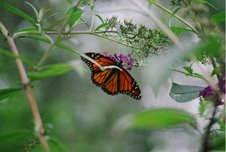
Paper Plate hibiscusHibiscus a summertime delight. Summertime is a very active time in the garden with butterfly bushes and hibiscus overflowing everywhere. In my small garden yesterday I counted over 40 butterflies. Growing the right plants to attract wildlife is easier than you may think. Provide water and food and watch your garden attract all kinds of insects and birds. This summer we had more nesting birds than ever before. The usual robins and cardinals have a new neighbor, a family of orioles. So far too fast to sit for a picture.

Tuesday

Wow Long Time

Astilbe flowers
Bonsai Trees
Peony flower
Oh well I have been busy onj other projects but here is a little update. A family of Orioles has moved in and set up a nest. This is unusual as we don't see any orioles in the past, except for the passing migrant. Garden is over flowing and I have a lot of supply for those that are looking to fill up their garden or maybe just get started . So check it out and holler back!

Saturday

First Day of Summer

Roses
"Some people are always grumbling because roses have thorns. I am thankful that thorns have roses."
– Jean-Baptiste Alphonse Karr

Wednesday

Bats, Birds, Insects and Poppies?

bat house Bats, Birds and Bugs. Set up the very things that beneficial animals and insects need to come to your garden. Bats will eat hundreds of mosquitoes every night and Birds and beneficial insect will help keep your garden pest free.

poppy flowers
border garden
orange poppies

Friday

Making a small garden seem Big

For-Get-me-nots Creating distance in a small garden can be a challenge, but by creating a view that focuses your eye will help. I often take pictures at odd angles to promote different views. The more layer that you can see creates more and more depth.

Tuesday

Bonsai

Bonsai, the ancient art of miniaturizing nature, Growing natural trees in a small way. Tree in pot. Sounds easy but when practiced one finds it much more difficult than usually thought. To grow healthy Bonsai trees all of its needs have to be met, from water, sun light, and fertilizers and pruning. Learning all this takes time and research, this time and effort will be well rewarded if implemented.

When starting out to grow your own bonsai trees it is highly recommended to use local native species. You can make a lot of educational mistakes that won't cost you an arm and a leg. Many people start with tropical trees that can be grown inside in the winter in areas too cold for their survival. Tropical bonsai tend to be faster growing than the non tropical trees that usually need a cool or even a cold winter to mature.

Patience is the first and most important attribute that someone needs to grow bonsai. Many of the best trees can actually out live the grower. When the proper care and environment is created a Bonsai tree can live over one hundred years. Many of these specimen trees are handed down through generations. These trees can fetch thousands of dollars if they are ever sold.

Selecting the plant material that you want to use can vary from the tropical to the local trees, but can also include perennial plants like herbs and chrysanthemums. As these plants are not as long lived and also grow much faster will help you on your educational path.

Yes, Using herbs as bonsai has been done for centuries. Small leaves and a mature looking growth in one season can help in the learning process. When I was in Japan I was there for the chrysanthemum festival and on display were a number of different herbs as bonsai. The chrysanthemum on display had feature as intricate as full grown forests. The great thing about Bonsai as an art is to mimic nature in a smaller form. Have fun with what ever plant materials you want to use. Most of the original bonsai art was done with local and native plants.

Today the most sought after Bonsai trees are from Japan, China and Asia, as these trees have the images that people are looking for in the Art of Bonsai. If You seek out these trees be prepared to spend good money to get them. Most important is that as a Bonsai enthusiast getting started is the first step.

The great thing about using herbs and other perennials is that you will get faster growth and you will learn more. The more you try to do, the better skills you will develop. And if you make a mistake with a perennial you have not lost a long lived tree. Bonsai can be very rewarding and may teach you a few things in the process. Seek out the help you will need from the many that have gone before you, their knowledge is priceless. http://www.jerseygardener.com/
 Don't Kill Your Bonsai